
How the Boone County Court Calendar Works
Boone County has no single public calendar for every setting. No one document pulls together circuit, family, magistrate, and municipal dates. You follow the record for whichever court has the case. MCR displays a Case Event Schedule for magistrate matters. WVPASS docket entries and filed notices or orders serve as the public electronic route for circuit and family cases. Municipal ordinance calendars stay with the municipality itself.
Each setting belongs to a case, a court, a judge, an event type, and a date. Some get individual times. Others sit on a docket call. Be careful what a document is not. The annual statistical report is not a calendar. The Judiciary's active-case dashboard is not a hearing list. A filing date or CourtPLUS receipt with a timestamp still does not become a hearing date.
Boone County Circuit Court Terms
Under Trial Court Rule 2.09, Boone County circuit terms begin on the third Monday in January, April, and September. Think of those Mondays as structural markers in the court year. Nothing about them promises that your trial, arraignment, motion, or conference lands on opening day.
Use the term schedule as background only. The real appearance date comes from the latest case event, a signed order, or confirmation from the clerk. One term holds many separate settings, and later changes happen. Assuming the term's opening Monday is your hearing date invites a missed appearance or a wasted trip.
Term date versus case date: a Boone County term begins under a statewide rule, while an individual setting comes from the judge's notice, order, or case event.
Boone County Court Date Lookups
Start by identifying which court sent the notice. It may be Circuit Court, Family Court, Magistrate Court, or a municipality. Then copy the number exactly as printed. A circuit civil number may look like CC-03-2020-C-82. A magistrate criminal example looks like 24-M03F-00055. The wrong format in the wrong system will not find the setting.
- Open WVPASS for circuit or family court, or pass the MCR CAPTCHA for a magistrate matter.
- Search the complete case number when known; MCR also permits first-name and last-name fields.
- Open the Boone County result and locate the newest setting, notice, or order.
- Write down the event type, date, time, room, location, judge, and status.
- Call the responsible clerk to confirm whether the setting is firm, continued, virtual, or part of a docket call.
- Check the official Judiciary closure page shortly before travel and follow counsel's or the court's latest notice.
For Circuit Court, call the circuit clerk at 304-369-7320. Or visit 200 State Street, Suite 202, Madison. Family Court lists a Boone contact at 304-369-7847 on 206 Court Street. For Magistrate Court, dial 304-369-7366. A courthouse posting or a courtroom docket call can supplement the online court record. The clerk can tell you where the current public schedule hangs. If counsel represents you, confirm the date with counsel too.
Record Six Boone County Setting Fields
Never jot down a bare date. A good calendar note carries enough detail to tell two same-day hearings apart and to catch a later change. MCR's event schedule offers a practical field set. The same fields work when a clerk reads the setting to you over the phone.
| Field | What to record |
|---|---|
| Case number | The complete identifier, including court and Boone County code. |
| Event type | Preliminary hearing, status, motion, pretrial, trial, or the exact label given. |
| Date and time | The full date, local time, and whether it is a general docket call. |
| Room and location | Building, courtroom, floor, or remote instructions. |
| Judge or court | The listed judicial officer or court assignment. |
| Status | Firm, continued, canceled, completed, or awaiting confirmation. |
Read the details back after a clerk gives them by phone. Note when you got the public information and from whom, and never ask the clerk for legal advice.
Court Settings: What Each Field Means
One setting line is a scheduling record, nothing more. Read every field together. Then compare them against the most recent docket entries. On MCR, the label "Hearing/Event Closed" can simply mean the scheduled event ended. It does not necessarily mean the case was dismissed, sealed, or fully concluded.
| Date | The scheduled calendar day, subject to a later continuance or cancellation. |
|---|---|
| Time | The listed start or docket-call time, not an estimate of when the matter will finish. |
| Courtroom | The room or location tied to that event; confirm the building before travel. |
| Judge | The judicial officer or assignment shown for the setting. |
| Setting type | The event's purpose, such as preliminary hearing, status, pretrial, motion hearing, or trial. |
| Reason closed | An event-level status field that should not be mistaken for final case disposition. |
Boone County Remote Hearings Need Direct Confirmation
Trial Court Rule 14.04 lets magistrate courts hold video proceedings for certain matters. The rule covers non-evidentiary matters, not-guilty pleas, pretrial or status proceedings, and specified domestic-violence ex parte matters. The official Boone County court page gives the local court and clerk contact route for verifying a setting.
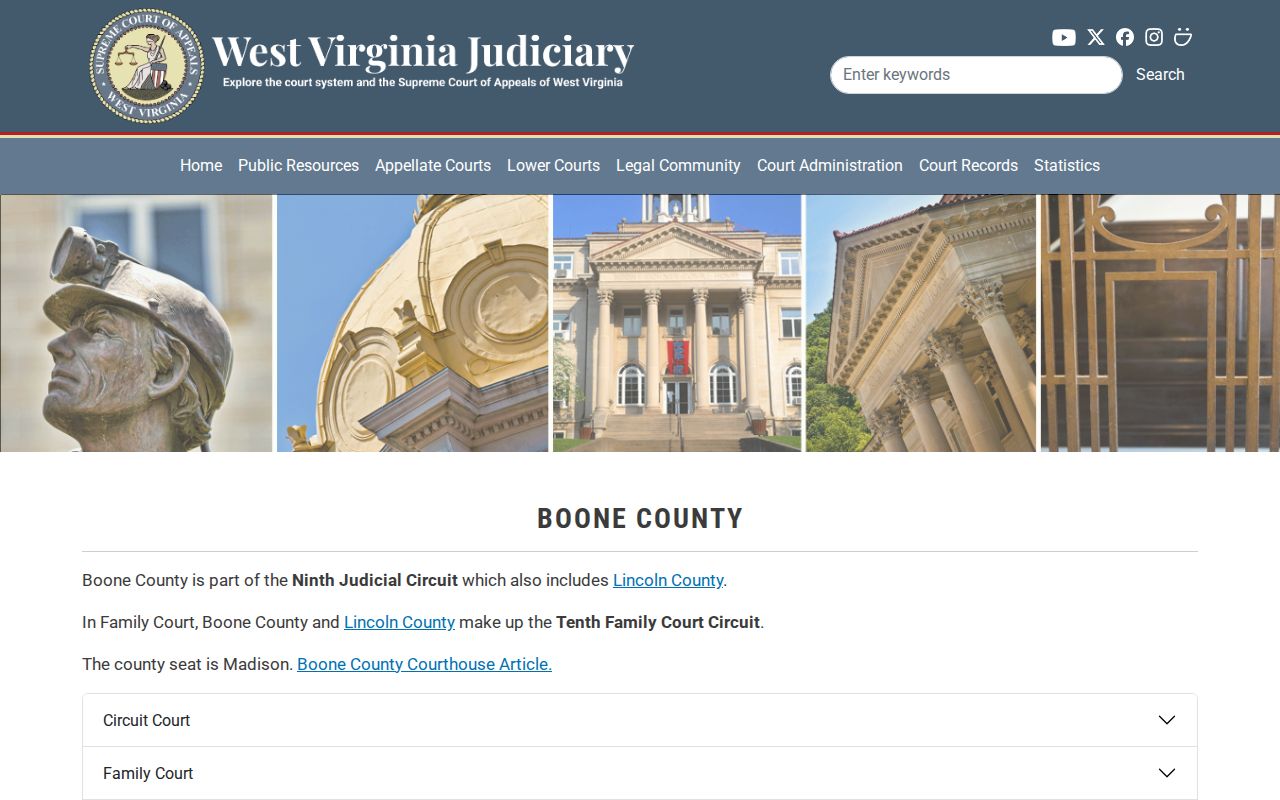
That county page is a contact and court-assignment source. It does not prove a hearing will be remote. The court's notice or order controls. Permission in the rule does not make every Boone County hearing remote. Ask whether the event is in person, by video, or hybrid. For remote access, verify the platform, join instructions, deadline, identity-check process, and any advance filing requirement. Never reuse an old meeting link. For an in-person public hearing, confirm the building, room, entrance, security rules, and accessibility needs. Also check any limits on recording or photography.
When a Boone County Court Date Moves
A party can request a continuance. But a motion to continue is not proof the judge granted it. Keep the original date for now. Wait for an order, an updated event, the clerk, or your attorney to confirm the change. Even after a new setting appears, an old event can linger. A canceled or completed event may still sit in the history.
Look at the newest docket rows in WVPASS or the Case Event Schedule in MCR. A magistrate felony may be waived or transferred to Circuit Court. That can create a new number and a new search path. Family and confidential matters may not show the same public detail. Municipal dates must be confirmed with the municipality. The state portals do not establish a municipal schedule.
A filed continuance request does not move a Boone County hearing until the court approves the change and issues updated setting information.
Weather, Closures, and Boone County Schedule Checks
A storm can shift a hearing date. Other operational problems can too. The date, its location, or how you attend may all change. The West Virginia Judiciary runs a court-closures page worth checking before you travel. Boone County was open on the most recent status, but that can change fast. Look again close to your court date. Read any notice the court sends you directly.
A closure page tells you whether an office is running. It rarely spells out each case's new setting. Once a closure ends, run a docket search. Then call the Boone County clerk about rescheduling. A shut building does not always cancel remote events. Reopening does not always restore the original time. Save any official notice, along with when you checked it.
Missed Settings and What Comes Next
Missed a Boone County court date? Act fast. Look up the court docket for your case and read the latest entries. A failure-to-appear notation, a warrant, a new setting, a dismissal, or some other order may already be on file. Check what the docket actually says rather than guessing the outcome. Then call the clerk's office, and your lawyer too if you have one. Give them the case number. Ask how to handle the missed event and what is currently scheduled.
Missed a setting? Consequences depend on the case and can include a failure-to-appear entry, warrant, bond action, dismissal, or other court order.
Call the correct Boone County clerk at once and seek legal advice about the proper filing or appearance.
Do not simply arrive at a courtroom or submit payment without verifying the current case status.
Traffic tickets follow their own deadlines and failure-to-appear rules. In some situations a prosecutor can ask a judge for a warrant. License consequences may also run on a separate administrative track, so the docket entry, your payment status, and any license action do not always move together. For the citation-specific route, use the Boone County traffic court page.
Boone County Family and Municipal Calendar Boundaries
Family Court settings can touch on restricted material. WVPASS leaves out sealed and juvenile filings. Public access to a court docket does not permit publishing details about children, victims, medical matters, or protected finances. The Boone Family Court contact can confirm what scheduling information is public. The circuit clerk keeps the circuit and family record structure. Ask only for what you need to attend or follow a public setting.
Madison, Danville, Whitesville, and Sylvester have no statewide municipal docket or calendar. Take a local ordinance matter straight to that town's clerk, recorder, mayor's office, or designated court custodian. Neither MCR nor WVPASS proves a municipal court date. Federal cases filed in Boone County run separately. They move through PACER and the Southern District of West Virginia's Charleston Division.
Boone County Calendar Data Is Not Caseload Data
Annual reports tally filings by reporting category. The 2026 Judiciary dashboard offers preliminary active-case counts refreshed daily. Neither one is a hearing calendar. A full docket also lists past procedural events. Those old entries are not future settings.
For a single case, trust its current event schedule, notices, and orders. For Boone County workload history, use the finalized annual report and name the year. For day-to-day operation, check closures and call the clerk. Keep each source in its lane. That stops an aggregate total or stale event from being mistaken for a real court date someone must attend.